
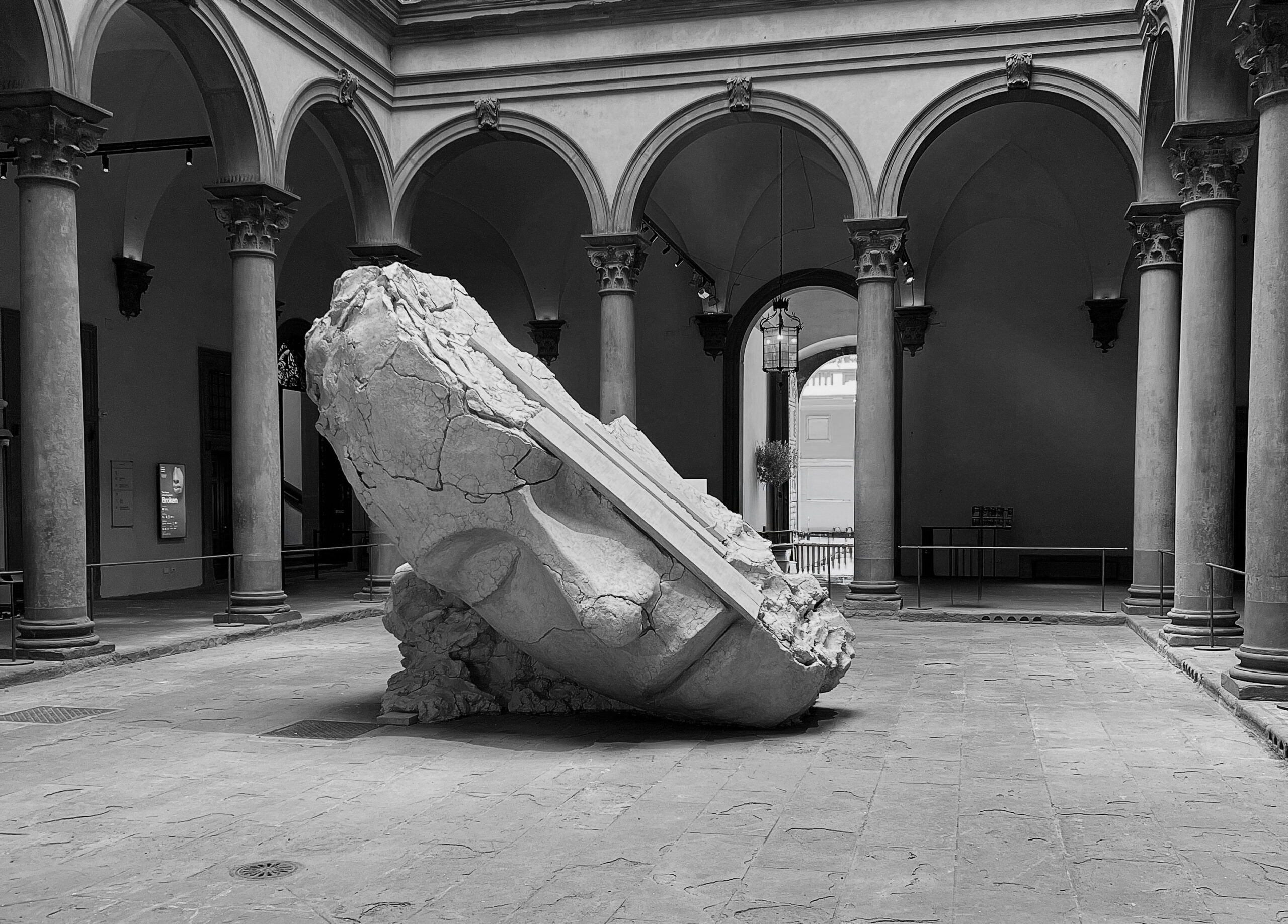
A Palazzo Strozzi il frammento smette di essere ciò che resta e diventa ciò che parla.
Da Giovanni Pisano a Michelangelo, da Canova a Rodin, da Giacometti a Louise Bourgeois e Francesco Vezzoli, una mostra mette in crisi l’ossessione per l’opera integra e ci ricorda che, nell’arte, la perdita può essere una forma di presenza.
C’è qualcosa di profondamente sospetto nell’idea di opera d’arte integra. La guardiamo come se la sua completezza fosse una garanzia: tutto al suo posto, nessuna lacuna, nessuna frattura, nessuna parte mancante. Come se l’arte, per essere davvero tale, dovesse arrivare a noi senza ferite.
Broken. Il potere del frammento, la grande mostra che Palazzo Strozzi dedica al frammento dal 25 settembre 2026 al 24 gennaio 2027, parte esattamente da questa certezza per incrinarla. E lo fa con una domanda tanto semplice quanto destabilizzante: siamo davvero sicuri che un’opera abbia bisogno di essere intera per essere compiuta?
La risposta della mostra è, naturalmente, no. Ma il punto interessante è che Broken non si limita a celebrare il frammento come una categoria estetica alla moda. Lo tratta come una condizione storica, materiale e persino politica.
Un frammento può essere ciò che rimane dopo una guerra, una catastrofe, una distruzione deliberata, un saccheggio, una trasformazione rituale. Oppure può essere una scelta dell’artista. Può essere ciò che resta di un’opera perduta oppure ciò che l’artista ha deliberatamente deciso di non completare. È qui che la mostra diventa più interessante, a partire dal suo stesso titolo.
Perché broken non significa semplicemente “rotto”. Significa anche interrotto, mutilato, separato, incompleto. E soprattutto significa sottratto alla pretesa di essere definitivo.
Palazzo Strozzi riunisce oltre ottanta opere provenienti da epoche, culture e geografie differenti: dall’antico Egitto alla Grecia, dall’Etruria al mondo romano, fino a culture del Messico, del Mali, del Perù e della Cambogia. Accanto alla dimensione archeologica compaiono alcuni dei grandi nomi della storia della scultura, da Giovanni Pisano a Michelangelo, da Antonio Canova ad Auguste Rodin, fino alle ricerche moderne e contemporanee di Alberto Giacometti, Louise Bourgeois e Francesco Vezzoli.
Il risultato è un ribaltamento di prospettiva: non siamo più noi a guardare un pezzo di un’opera perduta. È il pezzo stesso che sembra guardarci. Il museo ama ciò che è intero. La storia, invece, no.
Il museo nasce anche dal desiderio di conservare, classificare, ordinare. La storia dell’arte, almeno nella sua versione più rassicurante, ha spesso cercato di ricostruire l’unità: trovare il braccio mancante, ricomporre il corpo, identificare l’autore, stabilire la data, ricostruire l’originale. La domanda che sorge è la seguente: l’opera rotta è più sincera?
Forse la provocazione più interessante di Broken sta proprio qui. Non nel dire che il frammento sia più bello dell’opera integra. Sarebbe un’altra forma di estetizzazione, un altro feticismo. Il punto è un altro: l’integrità non è una condizione definitiva del significato.
Un’opera può perdere una parte e acquistare una storia. Può perdere la sua funzione originaria e acquisire un’altra identità. Può essere distrutta e diventare testimonianza della distruzione. Può essere incompleta e diventare più aperta. Può essere mutilata e, proprio attraverso la mutilazione, raccontare qualcosa che nella sua forma originaria non avrebbe potuto raccontare.
Il frammento porta con sé un prima e un dopo. È sempre un oggetto con una biografia. E forse per questo ci inquieta.
Un’opera integra pretende di essere presente. Un frammento ci ricorda che ogni opera è anche passato.
Di Sara Allegrini
BROKEN
THE POWER OF THE FRAGMENT
At Palazzo Strozzi, the fragment ceases to be what remains and becomes what speaks.
From Giovanni Pisano to Michelangelo, from Canova to Rodin, from Giacometti to Louise Bourgeois and Francesco Vezzoli, an exhibition challenges our obsession with the intact work of art and reminds us that, in art, loss can be a form of presence.
There is something deeply suspicious about the idea of an intact work of art. We look at it as though its completeness were a guarantee: everything in its place, no gaps, no fractures, no missing parts. As if art, to truly be art, had to reach us without wounds.
Broken. The Power of the Fragment, the major exhibition dedicated to the fragment at Palazzo Strozzi from September 25, 2026, to January 24, 2027, takes precisely this assumption and sets out to undermine it. And it does so with a question as simple as it is unsettling: are we really sure that a work of art needs to be whole in order to be complete?
The exhibition’s answer is, of course, no. But what makes Broken interesting is that it does not merely celebrate the fragment as a fashionable aesthetic category. It treats it as a historical, material, and even political condition.
A fragment may be what remains after a war, a catastrophe, an act of deliberate destruction, a looting, or a ritual transformation. Or it may be the result of an artist’s choice. It may be what survives of a lost work, or what the artist deliberately decided to leave unfinished. This is where the exhibition becomes most compelling, beginning with its very title.
Because broken does not simply mean “damaged.” It also means interrupted, mutilated, separated, incomplete. Above all, it means freed from the expectation of being definitive.
Palazzo Strozzi brings together more than eighty works from different periods, cultures, and geographical regions: from ancient Egypt to Greece, from Etruria to the Roman world, and extending to cultures from Mexico, Mali, Peru, and Cambodia. Alongside the archaeological dimension appear some of the greatest names in the history of sculpture, from Giovanni Pisano to Michelangelo, from Antonio Canova to Auguste Rodin, through to the modern and contemporary explorations of Alberto Giacometti, Louise Bourgeois, and Francesco Vezzoli.
The result is a reversal of perspective: we are no longer simply looking at a piece of a lost work of art. It is the fragment itself that seems to be looking back at us. The museum loves what is whole. History, on the other hand, does not.
The museum was also born out of the desire to preserve, classify, and organise. Art history, at least in its most reassuring version, has often sought to reconstruct unity: to find the missing arm, reassemble the body, identify the artist, establish the date, reconstruct the original. Which raises a question: is a broken work of art more honest?
Perhaps the most interesting provocation of Broken lies precisely here. Not in claiming that the fragment is more beautiful than the intact work. That would simply be another form of aestheticisation, another kind of fetishism. The point is something else entirely: wholeness is not a definitive condition of meaning.
A work of art can lose a part and gain a history. It can lose its original function and acquire another identity. It can be destroyed and become a testimony to destruction. It can be incomplete and become more open. It can be mutilated and, through that very mutilation, tell us something that its original form could never have conveyed.
The fragment carries within it a before and an after. It is always an object with a biography. And perhaps that is why it unsettles us.
An intact work of art claims to exist entirely in the present. A fragment reminds us that every work of art also belongs to the past.
By Sara Allegrini